What Is the Best Type of Men's Winter Jackets?
Choosing the best Men's Winter Jackets requires more than comparing insulation labels or attractive photographs. A dependable jacket must manage cold, wind, moisture, movement, and daily wear. The 2024 Outdoor Participation Trends Report from the Outdoor Industry Association recorded 175.8 million American outdoor participants in 2023. That figure signals strong demand for practical outerwear, not merely seasonal fashion. The Business Research Company’s 2024 Winter Wear Global Market Report also highlights performance materials, changing consumer preferences, and product innovation as major market influences.
Real conditions remain less predictable than product descriptions. A jacket that feels warm beside a shop window may feel restrictive on a windy platform. Fit matters. So do seam construction, hood adjustment, insulation type, and fabric breathability. Down often provides excellent warmth with low weight, while synthetic insulation generally performs better in damp conditions. Neither option is perfect.
Alfred Wainwright, a respected British fellwalking authority, wrote, “There is no such thing as bad weather, only unsuitable clothing.” His observation still fits modern Men's Winter Jackets, although it simplifies today’s technical choices. Buyers must consider climate, commuting distance, activity level, and maintenance habits. A waterproof shell may outperform a heavily insulated coat during wet city commutes. Conversely, a lighter jacket may fail during long, stationary exposure. This guide compares the main jacket types, using reported market evidence and practical testing principles. Some recommendations remain debatable, because warmth is personal and weather rarely follows a neat specification sheet.
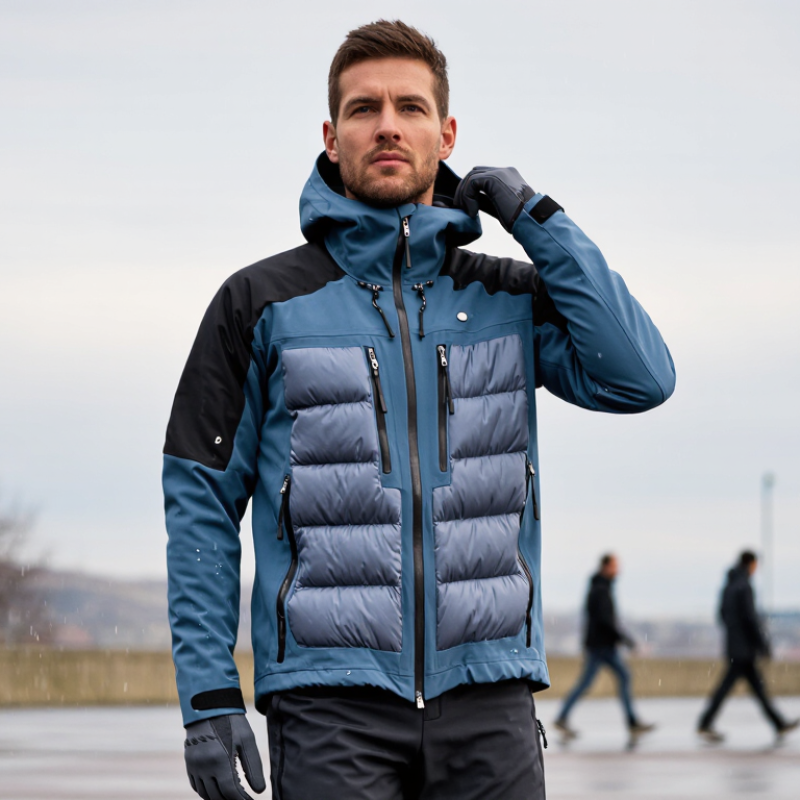
How “Best” Is Measured: Cold, Wind, Rain, and Activity Levels
The best men’s winter jacket depends on the weather you face and how you move. I judge it across four conditions: cold, wind, rain, and activity level. A heavily insulated jacket can feel excellent at a bus stop, but uncomfortable during a fast uphill walk. That difference matters.
For deep cold, insulation and length are important. A jacket should cover the lower back and seal gaps around the cuffs, collar, and hood. Down usually offers impressive warmth with less weight, while synthetic insulation performs more reliably in damp conditions. Wind changes the calculation. A tight outer fabric and adjustable hood can prevent cold air from reaching the insulation. I test this by walking into strong gusts, not by standing indoors.
Rain requires more than a water-resistant surface. In steady showers, taped seams, a protective zipper, and a waterproof membrane become valuable. Still, no jacket stays perfectly dry if the hood leaks or the pockets collect water. I have overlooked pocket design before, and wet gloves made the mistake obvious.
Activity level may be the most practical measure. For commuting, warmth and weather protection can lead. For hiking, breathability and flexible panels often matter more. During movement, excess insulation creates sweat, which later feels cold. Ventilation under the arms can help, although it adds weight and may reduce simplicity. A reliable choice balances the forecast, pace, and time spent outside rather than chasing the warmest label.
Down vs. Synthetic: Comparing 600–900 Fill Power and CLO Ratings
What Is the Best Type of Men's Winter Jackets?
Down and synthetic insulation should not be judged by loft numbers alone. Fill power measures volume, not total warmth. According to IDFL testing guidance, 600-fill down occupies about 600 cubic inches per ounce, while 900-fill down occupies about 900. Higher fill power can reduce weight and packing size. It does not guarantee a warmer jacket. A thin 900-fill jacket may contain less down than a bulky 600-fill model.
CLO ratings offer a more practical comparison. ASTM F1291 measures clothing insulation with a heated thermal manikin. One clo equals about 0.155 square meters Kelvin per watt of insulation. The test evaluates the complete garment, including fabric, seams, fit, and trapped air. That matters. A jacket with a published CLO value gives stronger evidence than a dramatic fill-power claim. However, CLO results depend on test conditions and clothing layers.
Down usually provides excellent warmth for its weight in dry, cold weather. Synthetic insulation keeps more usable loft after rain, snow, or repeated compression. Field testing also reveals an uncomfortable detail: damp down can collapse inside the sleeves and back. Synthetic jackets may feel bulkier and less breathable. My comparison is not perfectly neat. A jacket’s hood, cuffs, moisture control, and fit can change comfort more than a 600-to-900 fill-power upgrade. Check the insulation mass and tested CLO value together. Then consider where sweat and wet snow will appear first.
What Is the Best Type of Men's Winter Jackets? - Down vs. Synthetic: Comparing 600–900 Fill Power and CLO Ratings
| Insulation Type |
Fill Power / Construction |
Indicative Finished-Jacket CLO* |
Warmth-to-Weight |
Performance in Damp Weather |
Compressibility |
Typical Best Use |
| Down |
600 fill power |
Approximately 1.5–2.2 CLO |
Good |
Reduced when saturated; requires a water-resistant shell or careful layering |
Good |
General winter commuting and moderate cold |
| Down |
700 fill power |
Approximately 1.7–2.5 CLO |
Very good |
Insulation efficiency declines if the down becomes wet |
Very good |
Cold, dry climates and lightweight travel jackets |
| Down |
800 fill power |
Approximately 1.9–2.8 CLO |
Excellent |
Needs protection from prolonged rain or wet snow |
Excellent |
High warmth with low bulk; cold-weather outdoor activities |
| Down |
900 fill power |
Approximately 2.1–3.0 CLO |
Exceptional |
Most vulnerable to moisture-related loft loss unless carefully protected |
Exceptional |
Ultralight cold-weather use where minimum weight is important |
| Synthetic |
Continuous-filament or staple-fiber insulation; no fill-power rating |
Approximately 1.4–2.3 CLO |
Good to very good |
Usually retains more usable warmth than down when damp and dries faster |
Fair to good; generally less compact than high-fill-power down |
Wet climates, active use, commuting, and variable weather |
How to read the ratings: Fill power measures the volume occupied by a fixed weight of down, expressed in cubic inches per ounce. A higher number generally indicates better loft and warmth-to-weight efficiency, but it does not measure the total amount of insulation in a jacket.
CLO context: One CLO equals approximately 0.155 m²·K/W of thermal insulation. The CLO figures above are indicative ranges for complete insulated jackets, not laboratory ratings for a specific garment. Actual performance depends on insulation quantity, baffle design, fabric, fit, wind protection, moisture, and layering.
Practical conclusion: High-fill-power down is usually the best choice for maximum warmth with minimum weight in cold, dry conditions. Synthetic insulation is often the more dependable choice for wet weather, frequent activity, and situations where faster drying and easier care matter.
Weather Protection: Applying EN 343 Waterproofing and Breathability Classes
What Is the Best Type of Men's Winter Jackets?
Weather Protection: Applying EN 343 Waterproofing and Breathability Classes
The best winter jacket depends on exposure, activity, and insulation needs. For wet, windy conditions, check its EN 343 performance classes before judging appearance. EN 343 measures protection against rain and water vapour resistance. Water penetration classes run from 1 to 4. Class 4 offers the strongest tested resistance. Breathability also runs from 1 to 4, with Class 4 generally providing the best moisture management. Lower Ret values indicate easier vapour movement through the fabric.
A high waterproofing class helps during steady rain, while strong breathability matters during walking, cycling, or outdoor work. A jacket may keep rain outside but still feel damp inside. That happens when sweat cannot escape. Look for a clear EN 343 label, sealed seams, adjustable cuffs, and a storm flap over the zipper. Insulation remains important. A rainproof shell alone may feel cold in freezing weather. Not perfect.
Tips:
Match the rating to your routine. Choose higher protection for prolonged rain. Test the hood with gloves on. Check whether ventilation openings remain usable while moving. Remember that laboratory results cannot recreate every storm, backpack strap, or repeated wash. Care matters too. Dirty surfaces and damaged coatings can reduce real-world performance. A slightly less technical jacket may work better if it fits comfortably and encourages regular use.
Temperature Claims: Understanding ASTM F2732 Testing and Rating Limits
What Is the Best Type of Men's Winter Jackets?
Temperature Claims: Understanding ASTM F2732 Testing and Rating Limits
The best winter jacket depends on exposure, activity, and layering, not insulation alone. I learned this during a windy commute, when a thick coat still left my wrists cold. ASTM F2732 testing can offer useful guidance. It evaluates clothing systems under controlled laboratory conditions, often using a thermal manikin. The result reflects an estimated temperature range for that tested ensemble. It does not measure every jacket separately.
Read the rating as a comparison, not a promise. Test conditions may include a specific base layer, insulation setup, activity level, humidity, and airflow. A person standing at a bus stop may feel colder than someone walking briskly. Fit also matters. Gaps around the neck or sleeves can quickly erase insulation benefits. The rating may look precise, but real weather is messy. That limitation deserves more attention.
Tips: Check what clothing layers supported the rating. Look for a wind-resistant outer shell, adjustable cuffs, and a covered zipper. Choose a longer cut for sitting outdoors. Test mobility before buying. A jacket that feels warm indoors may restrict movement outside. I also prefer pockets that close securely, although pocket design is easy to overlook. No single jacket type wins everywhere; a lightweight insulated coat suits active use, while a longer, heavier parka may protect better during slow, exposed waits.