Leave Your Message

10 Best Softshell Jackets for Men in 2026

A softshell jacket is built for the in-between moments: a windy ridge, a chilly trailhead, or a damp walk when a rain shell feels excessive. The Outdoor Industry Association’s 2024 Outdoor Participation Trends Report estimated that 175.8 million Americans took part in outdoor recreation in 2023, representing 57.3% of the U.S. population aged six and older. That broad participation figure does not prove demand for any particular jacket, but it shows how many people may need adaptable layers for time outside.

For this 2026 guide, the best Softshell Jacket Men options should be compared on practical details, not marketing claims alone. Look for comfortable stretch, useful wind resistance, sensible pocket placement, and enough breathability for movement. Check the hood, cuffs, and hem, too; a loose cuff can let cold air in, while a bulky hood may bunch under a pack. No single jacket handles every forecast. That matters.

Softshells generally suit active use in cool, breezy conditions, but they are not automatic substitutes for waterproof rainwear. Product specifications can differ, and weather resistance varies by fabric and construction. A dependable comparison should distinguish manufacturer claims from verified test results, then explain the trade-offs in plain language. The right pick depends on fit, activity, layering habits, and local weather. Sometimes, the less rugged-looking jacket is the one you reach for most.
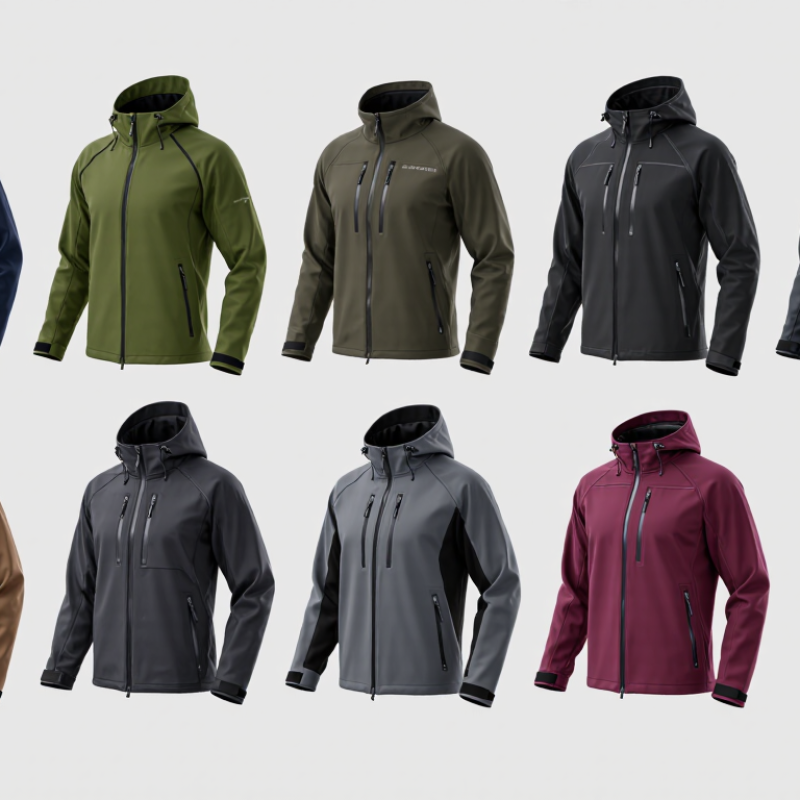
10 Best Softshell Jackets for Men in 2026

Softshell Jackets Explained: Stretch, Wind Resistance, and DWR

A softshell jacket balances stretch, wind resistance, and light weather protection. Its woven face usually moves more freely than a hardshell, making it comfortable for steep trails or reaching overhead. But stretch alone does not mean warmth. A thin softshell can feel cold when wind cuts through its fabric, so check the garment’s construction and intended activity.

Wind resistance matters even in cool, dry weather. NOAA’s 2001 wind-chill report estimates that 20°F air feels near 4°F at 20 mph wind; that describes exposed-skin risk, not a jacket’s lab rating. Durable water repellent, or DWR, helps water bead on the surface, but does not make a jacket waterproof. AATCC TM22 evaluates this surface wetting with spray ratings from 0 to 100. The treatment can also wear down with use and washing.

Tips: Check the fabric label and care instructions, then test the fit with a fleece underneath. For steady rain, choose a waterproof shell instead. One easy mistake is expecting one softshell to handle every forecast; even a well-made jacket has limits.
Breathability Metrics: ISO 11092 RET and ASTM D737 Airflow Testing

When comparing men’s softshell jackets, breathability numbers can help, but they describe different things. ISO 11092 measures evaporative resistance, reported as RET, using a controlled heated plate. A lower RET generally means sweat vapor can pass through the tested material more easily. It does not guarantee you will feel dry during a steep climb.

ASTM D737 measures air permeability: how much air passes through fabric under a specified pressure difference. Higher airflow may feel welcome on a windy ridge, yet can also mean less wind protection. Check that comparisons use similar test conditions. Fabric samples do not behave exactly like finished jackets, where seams, linings, pockets, and fit all matter. Small details count.

I’d read RET and airflow together, then consider your usual pace and weather. For a brisk walk in cool, gusty conditions, unrestricted airflow may not be ideal. For uphill effort, a more breathable fabric could help reduce clamminess beneath a pack. Try the jacket while moving, not only under store lights. Feel the back panel after a few minutes. Lab data gives useful direction, but I still find it easy to overread one number. Test methods and garment construction leave room for surprises.

Weather Protection Benchmarks: Hydrostatic Head in mm and EN 343

For the 10 best men’s softshell jackets in 2026, weather protection deserves more than a quick glance at the fabric label. Hydrostatic head, measured in millimeters, indicates how much water pressure a material can resist before leaking. A higher figure can help during steady rain, but it does not guarantee a dry jacket. Seams, zippers, wear, and fit all affect real-world performance. Numbers need context.

EN 343 provides another useful reference for clothing designed to protect against rain. Its ratings cover water penetration resistance and breathability, so check both rather than focusing on a single class. Also look for whether testing applies to the fabric, seams, or finished garment. A jacket may feel comfortable on a windy walk yet struggle in a long, wet downpour. I’ve found that small details, like water pooling at a cuff, can matter more than a headline figure.

Tips: Match the hydrostatic-head rating to your usual conditions, and check the EN 343 label for clear performance details. Try the jacket with your usual layers; sleeves that ride up can let rain in. A softshell is not always a substitute for a dedicated waterproof shell. That distinction is easy to overlook.

10 Best Softshell Jackets for Men in 2026 — Weather Protection Benchmarks: Hydrostatic Head in mm and EN 343
Rank Softshell selection profile Best suited to Hydrostatic-head target EN 343 water-penetration threshold equivalent Weather benchmark
1 High-protection, fully seam-sealed softshell Prolonged wet-weather hiking and exposed routes 20,000 mm Class 4 threshold equivalent Highest target in this comparison; prioritize verified test results and construction details.
2 Alpine softshell with storm-focused construction Windy ridgelines and changeable mountain weather 15,000 mm Class 4 threshold equivalent High water-pressure target; hood, cuffs, and seams also affect practical protection.
3 Four-season trekking softshell Day hikes with intermittent rain 10,000 mm Class 4 threshold equivalent Strong target for a softshell profile; not a substitute for checking certified garment performance.
4 Water-resistant, seam-sealed trail softshell Mixed trail conditions and short showers 5,000 mm Class 4 threshold equivalent Useful benchmark for brief exposure; sustained rain may call for a dedicated waterproof shell.
5 Technical climbing softshell Active use where mobility and breathability matter 2,500 mm Class 4 threshold equivalent Meets the stated pressure threshold equivalent, but real-world performance depends on the complete garment.
6 All-round hiking softshell Cool, breezy days with occasional light rain 2,000 mm Class 3 threshold equivalent Below the Class 4 pressure threshold; consider a separate rain layer for prolonged precipitation.
7 Stretch-focused active softshell Fast hiking and high-output outdoor activities 1,500 mm Class 3 threshold equivalent Moderate pressure target; balance water resistance against breathability and comfort.
8 Lightweight wind-resistant softshell Dry, windy conditions and layering 1,000 mm Class 2 threshold equivalent Limited rain benchmark; best treated as wind protection rather than a rain jacket.
9 Everyday commuter softshell Urban use and brief light showers 800 mm Class 1 threshold equivalent Low water-pressure target; an umbrella or waterproof outer layer may be needed in rain.
10 Breathable, water-repellent softshell Dry-weather walking and active layering 500 mm Below the Class 1 threshold equivalent Primarily a wind and light-splash benchmark; not intended for sustained rain protection.

These are generic selection profiles and target benchmarks, not specifications or test results for specific jackets. EN 343 classes require testing of the garment under the applicable standard; a hydrostatic-head figure alone does not establish EN 343 certification. Approximate water-column conversions use 1 mm H₂O ≈ 9.81 Pa: Class 1, 800 Pa (≈82 mm); Class 2, 8,000 Pa (≈816 mm); Class 3, 13,000 Pa (≈1,326 mm); Class 4, 20,000 Pa (≈2,039 mm).

Comparing 10 Men’s Softshell Jackets by Weight, Fit, and Technical Ratings

A useful comparison of ten men’s softshell jackets starts with weight, but the lightest option is not automatically the best. A thin jacket may feel comfortable on a mild hike, yet offer less protection when cold wind cuts across an exposed ridge. Heavier fabric can feel reassuring, though it may become warm during a steep climb. Check the listed weight alongside fabric thickness, stretch, and ventilation rather than treating one number as a verdict.

Fit changes how each jacket performs. With the zip closed, reach forward as if gripping trekking poles; the hem should stay near your waist, and the shoulders should not pull. Try the jacket over a midweight layer if that is how you plan to wear it. Slim cuts can reduce loose fabric, but they may restrict movement. Roomier cuts allow layering, though a loose cuff can catch the wind. Small details matter.

Technical ratings also need context. Water-resistance scores, breathability figures, and wind protection are measured in different ways, so ratings may not compare directly across testing systems. Look for clear test methods and practical features, such as adjustable cuffs, a usable hood, and pockets that remain accessible under a pack belt. A high rating can sound convincing. Still, no chart captures every body shape or changing weather, and sizing notes can be imperfect. Treat the scores as evidence, then consider how the jacket feels during real movement.

Choosing a Softshell by Activity, Layering Needs, and Temperature Range

The right men’s softshell jacket depends less on a temperature label than on your pace, exposure, and layers. For a steep hike, prioritize breathable fabric and easy venting; you can warm up quickly on a climb. For cold, windy walks, a close-fitting hood and adjustable cuffs help limit drafts. Small details matter.

Think about what you will wear underneath. A trim jacket may fit well over a thin base layer but feel restrictive over a fleece. Try reaching overhead and bending your arms before choosing a size. On a cool morning, a light midlayer can add warmth, but too many layers may trap sweat during hard activity. That balance takes a little trial and error.

Softshells usually resist light rain and wind, but they are not a substitute for a waterproof shell in sustained rain. For changeable conditions, look for a fabric that moves moisture and a cut that allows comfortable layering. Check pocket placement with your pack or harness, too. A pocket blocked by a waist belt is less useful than it seems. Match the jacket to your usual activity and local weather, then leave room for conditions to surprise you.